Prop Money Dollars Explained Step by Step
Derek H. bought 40 counterfeit $100 bills for $1,200. ATMs credited $800, but his bank froze the account the next morning.
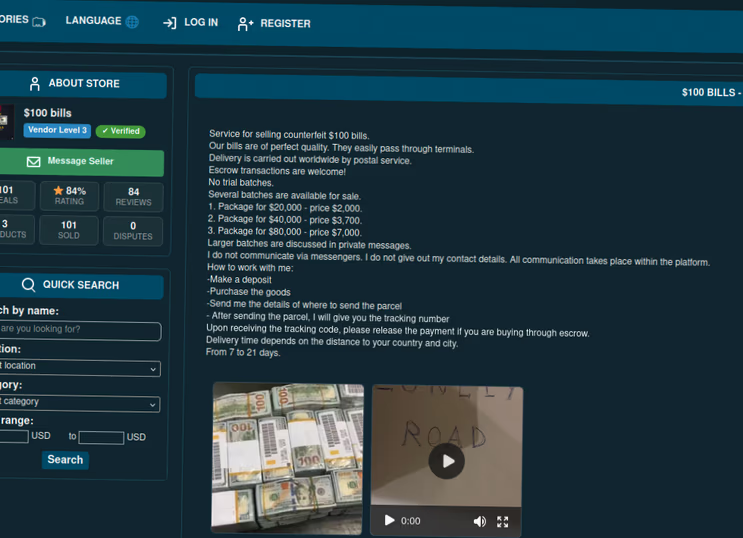
The pictured interface advertises counterfeit United States dollars and purchase terms.
You cannot confirm the marketplace where the transaction occurred. No details regarding the seller’s site, link, or onion address are provided.
This scenario should be interpreted as a documented account. It does not detail the precise methods used by the bank for investigation.
You cannot verify the website where the purchase was made.
- Step 1: Examine the purchase claim
What did Derek think he had bought? It is essential to look at the seller's specific assurances.
In January of 2025, Derek H., a 29-year-old resident of Denver, Colorado, ordered counterfeit currency through a darknet platform. The transaction particulars are summarized below.
Record category Documented value Settlement medium Cryptocurrency Stated grade "Superdollar quality" Asserted security elements UV protection, magnetic strip, and watermark Banknote release 2009 series Transaction expenditure $1,200 Currency composition 40 counterfeit $100 bills The seller claimed that each fake $100 bill was visually indistinguishable from genuine ones. This assertion included both visual aspects and various machine-readable security elements.
You might come across terms such as fake money darknet or fake money site. Other searches may include buy fake dollars and fake dollar price. The $1,200 mentioned pertains solely to Derek's transaction and does not reflect a broader market value.
Terms like fake counterfeit money and fake money dollar bills lack precision. A counterfeit $100 bill does not equate to lawful theatrical currency. In contrast, prop money dollars serve as props. Searching for prop money for sale locally points to a different category.
- Step 2: Follow the intended conversion
How did Derek envision the operation of his scheme? It is crucial to distinguish his intentions from the results.
He intended to insert the bills into ATMs that accept cash. These machines would scan the currency and credit his bank account. Subsequently, he aimed to either withdraw or transfer the digital funds.
This method is similar to depositing a check, pending a thorough verification. An initial credit to the account does not guarantee the authenticity of the cash.
This discussion is focused on $100 bills, not fake $20 bills. Additionally, it does not involve efforts to purchase counterfeit $20 bills. The term realistic fake money australia is irrelevant to this context. Derek operated in Denver, Colorado.
- Step 3: Track each ATM response
What occurred with the ATMs? You need to examine the sequence of events closely.
- The initial two ATMs processed deposits without issue.
- These transactions credited Derek’s account with $800.
- The third ATM rejected a note, issuing an error message.
- The fourth ATM accepted its note but labeled the transaction as under review.
- The following morning, the bank froze Derek’s account.
The information does not specify the types of ATMs or their fraud detection capabilities. Thus, you cannot pinpoint the malfunction to a specific security element.
The term "100 dollar fake money" pertains to the bill denomination involved. However, the acceptance from two machines did not finalize Derek’s plan.
- Step 4: Recognize the investigation’s limit
How did the scheme come to light? You can trace the timeline, yet not every detail is clear.
A review was initiated due to the fourth ATM. Subsequently, the bank halted transactions by the next morning. After a span of three weeks, the U.S. Secret Service apprehended Derek.
The information lacks forensic results or details from the bank’s examination. There is no account of how the cryptocurrency transactions were tracked. A more comprehensive explanation would exceed the provided information.
One specific insight can still be gathered. Acceptance by the machines was temporary, but the subsequent review had legal ramifications.
Separate temporary credit from final acceptance
Treat Derek’s experience as a failed conversion scheme, not purchasing guidance. You can see how $800 appeared temporarily, yet scrutiny followed quickly.
The account ends with Derek’s arrest three weeks later. It does not report later charges, trial proceedings, or sentencing.
Where to look next
We collect these links for readers who want to compare options. Links.